
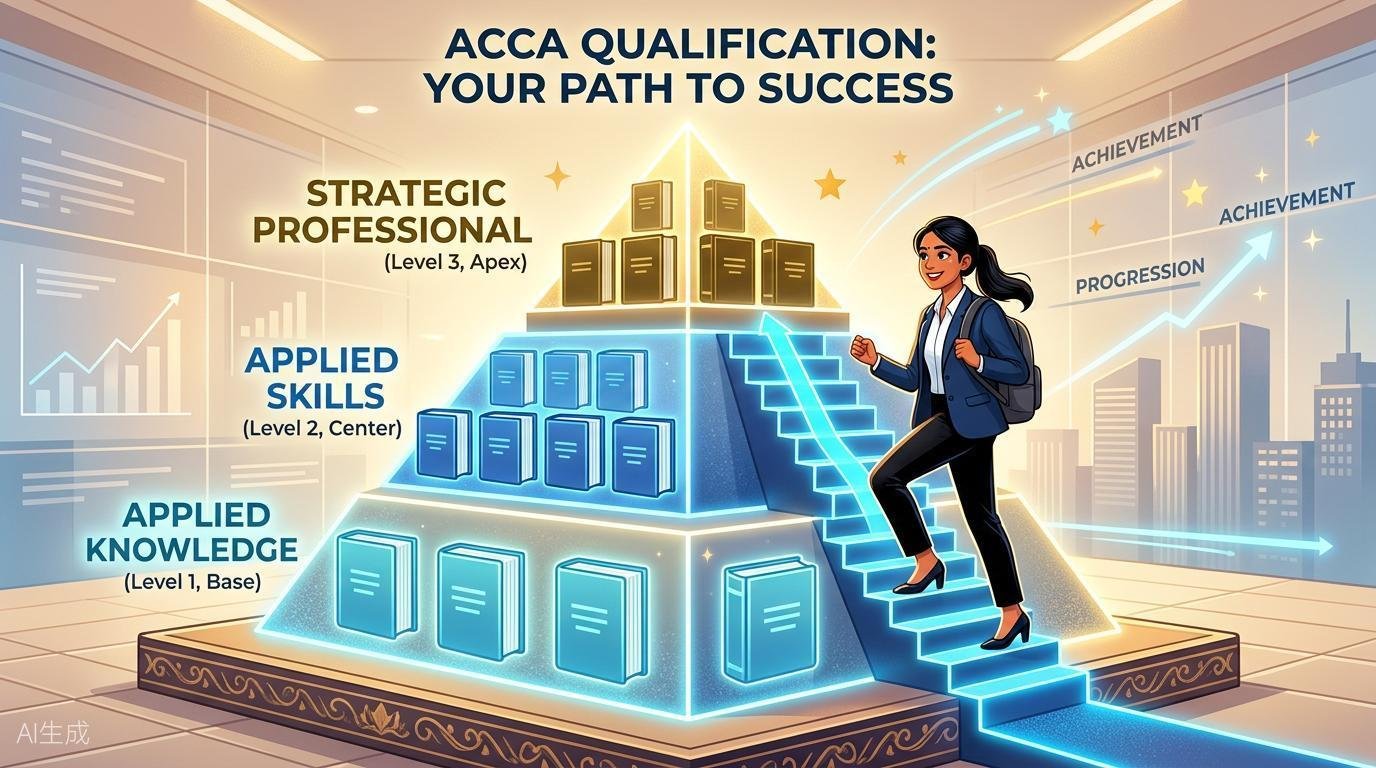
The ACCA qualification isn't just 13 exams — it's a carefully designed progression from accounting fundamentals to strategic leadership. Understanding how the three levels work, what each demands and how they connect is essential for planning your journey. Here's the complete 2026 breakdown.
Overview of ACCA's 3-Level Structure
According to ACCA Global, the qualification consists of 13 papers across three progressive levels: Applied Knowledge (3 papers), Applied Skills (6 papers) and Strategic Professional (4 papers — 2 compulsory Essentials and 2 chosen from 4 Options). Each level builds deliberately on the previous one, designed to transform a commerce student into a globally qualified finance leader.
In addition to the 13 exams, ACCA requires completion of the Ethics and Professional Skills Module (EPSM) and 36 months of Practical Experience Requirement (PER) before you can become a full member. EPSM should ideally be completed after Applied Knowledge and before starting Strategic Professional.
Level 1 — Applied Knowledge
Applied Knowledge is your entry point into ACCA. It introduces the fundamental concepts of business, management accounting and financial accounting. Think of it as building the foundation upon which everything else rests.
The Three Papers
BT — Business and Technology (F1): Covers business organization structure, governance, environmental influences, accounting's role in business, leadership, management theory and personal effectiveness. It answers the question "How do businesses work and where does accounting fit?" According to ACCA Global's December 2025 exam statistics, BT has an 87% global pass rate — the highest of any ACCA paper.
MA — Management Accounting (F2): Covers cost classification, overhead allocation, cost-volume-profit analysis, budgeting, standard costing, variance analysis and performance measurement. This is the first technically challenging paper for many students. The December 2025 global pass rate was 64%, reflecting the need for solid numerical skills.
FA — Financial Accounting (F3): Covers the conceptual framework of accounting, double-entry bookkeeping, preparing financial statements for single entities and simple groups and interpreting financial statements using ratio analysis. The December 2025 pass rate was 69%.
Exam Format
- Mode: On-demand Computer-Based Exams (CBE) — available anytime throughout the year
- Duration: 2 hours per paper
- Question types: Multiple choice, multiple response, fill-in-the-blank and drag-and-drop objective test questions
- Pass mark: 50%
- Result: Immediate upon completion
Study Approach
Applied Knowledge papers reward conceptual understanding over rote memorization. BT can often be completed with 40-60 hours of study. MA and FA typically require 60-80 hours each. Because these are on-demand exams, you can sit them when ready without waiting for quarterly sessions — a significant advantage for motivated students.
Level 2 — Applied Skills
Applied Skills is where ACCA transitions from "learning about accounting" to "doing accounting." These six papers develop the core technical competencies every professional accountant needs. According to ACCA Global, this level "develops your understanding of principle technical areas including financial reporting, taxation, audit and financial management."
The Six Papers
LW — Corporate and Business Law (F4): Covers essential elements of legal systems, contract law, employment law, company law and corporate governance. The December 2025 pass rate was 82%, making it one of the more accessible Skills papers.
PM — Performance Management (F5): Builds on MA with advanced costing techniques, decision-making, budgeting, performance evaluation and strategic performance measurement. PM is notoriously challenging — the December 2025 global pass rate was just 40%, the lowest among Applied Skills papers.
TX — Taxation (F6): Covers the tax system, income tax, corporate tax, capital gains tax, VAT/GST and tax administration. The December 2025 pass rate was 55%, reflecting the structured nature of tax calculations that many students find manageable with practice.
FR — Financial Reporting (F7): Covers conceptual frameworks, regulatory frameworks, preparing financial statements (including groups) and analyzing financial statements using IFRS. FR is considered one of the hardest Skills papers — the December 2025 pass rate was 51%.
AA — Audit and Assurance (F8): Covers the audit framework, planning, risk assessment, internal controls, audit evidence and audit reporting. AA had a 46% pass rate in December 2025. It requires understanding both technical standards and professional judgment.
FM — Financial Management (F9): Covers financial management functions, investment appraisal, working capital management, business finance, cost of capital and risk management. The December 2025 pass rate was 48%.
Exam Format
- Mode: Computer-Based Session Exams (CBE) — held in March, June, September and December
- Duration: 3 hours per paper (3 hours 15 minutes including reading time)
- Question types: Objective test questions plus constructed response questions (long-form answers)
- Pass mark: 50%
- Results: Released approximately 6-8 weeks after the exam session
Study Approach
Applied Skills papers typically require 100-150 hours of study each. The constructed response questions demand not just knowledge but application — you must analyze scenarios, calculate correctly under time pressure and communicate clearly. Many students attempt 1-2 papers per session at this level.
Level 3 — Strategic Professional
Strategic Professional is where ACCA transforms you from a technically competent accountant into a strategic business leader. This level focuses on leadership, advanced financial analysis, professional skepticism and real-world decision-making under uncertainty.
Essentials (Compulsory)
SBL — Strategic Business Leader: A unique integrated case study exam combining leadership, strategy, governance, risk management, technology, data analytics and organizational control. SBL is not tested by traditional questions — you receive a comprehensive case study and must respond as a senior business leader. The December 2025 global pass rate was 50%. Duration: 3 hours 15 minutes.
SBR — Strategic Business Reporting: Covers applying financial reporting principles, ethical and professional requirements, preparing group financial statements and analyzing financial reporting issues under IFRS. SBR had a 48% pass rate in December 2025. Duration: 3 hours 15 minutes.
Options (Choose 2 from 4)
AFM — Advanced Financial Management: For students targeting corporate finance, treasury and investment banking roles. Covers advanced investment appraisal, mergers and acquisitions, corporate reconstruction, treasury management and international financial management. December 2025 pass rate: 45%.
APM — Advanced Performance Management: For consulting, operations and strategic planning careers. Covers strategic performance measurement, performance evaluation, management control and performance management in not-for-profits. December 2025 pass rate: 41%.
ATX — Advanced Taxation: For tax advisory careers. Covers tax systems, tax planning for individuals and companies, international taxation and tax in financial decisions. December 2025 pass rate: 50% — the highest among optional papers.
AAA — Advanced Audit and Assurance: For audit and risk management careers. Covers audit framework, planning and risk assessment, audit of historical financial information and other assurance engagements. December 2025 pass rate: 38% — the lowest of all ACCA papers.
Exam Format
- Mode: Computer-Based Session Exams — March, June, September, December
- Duration: 3 hours 15 minutes (including reading time)
- Question types: Primarily constructed response — case studies, professional reports, board papers and advisory documents
- Pass mark: 50%
- Results: Released approximately 6-8 weeks after the exam session
All pass rates cited are from ACCA Global's official December 2025 and March 2026 exam statistics published at accaglobal.com. Pass rates fluctuate slightly each session but follow consistent patterns: Applied Knowledge > Applied Skills > Strategic Professional.
How the Levels Build on Each Other
ACCA's structure is intentionally sequential:
Knowledge → Skills: BT's business concepts feed into PM's performance management context. MA's costing foundations enable PM's advanced techniques. FA's financial reporting basics are essential for FR's group reporting. The transition is natural but steepens significantly.
Skills → Strategic Professional: FR's IFRS knowledge is assumed in SBR. FM's financial management principles are the foundation for AFM. AA's audit framework enables AAA. PM's performance measurement concepts feed into APM. The Strategic Professional level doesn't just test more advanced versions of the same topics — it tests whether you can use technical knowledge to make strategic decisions.
Can You Skip Levels?
No. ACCA's progression rules are strict: you must complete (or be exempted from) all Applied Knowledge papers before starting Applied Skills and all Applied Skills papers before attempting Strategic Professional. As ACCA states on their official website: "You can't attempt these advanced modules until you've cleared or been exempted from all nine Applied Skills papers."
However, exemptions can effectively "skip" papers. A qualified Indian CA receives up to 9 exemptions, meaning they start directly at Strategic Professional. A BCom graduate might receive up to 5 exemptions, skipping Applied Knowledge and some Skills papers. These exemptions are based on ACCA's assessment of your prior qualification's syllabus alignment.
Tips for Each Level
Applied Knowledge Tips
- Don't underestimate BT — its 87% pass rate makes it seem easy, but poor preparation leads to failure too
- Focus on understanding MA's costing concepts deeply — they reappear throughout ACCA
- Practice FA's double-entry rigorously; financial reporting builds on this foundation
- Take advantage of on-demand CBE flexibility — sit when ready, don't wait for sessions
Applied Skills Tips
- PM and AA have the lowest pass rates — allocate extra preparation time
- Practice constructed response questions extensively under timed conditions
- TX requires staying current with the latest tax amendments for your variant
- FR's group accounting is the single biggest challenge — master consolidation accounts
- Attempt 1-2 papers per session; overloading leads to failure and wasted fees
Strategic Professional Tips
- Complete EPSM before starting — it's required and provides valuable context
- SBL requires a completely different preparation approach — practice reading and analyzing long case studies
- Choose optionals based on career goals AND your strengths, not just pass rates
- Start exam technique practice early — time management is the biggest differentiator
- Read the examiner's reports — they reveal exactly what separates passes from failures
Side-by-Side Level Comparison
| Aspect | Applied Knowledge | Applied Skills | Strategic Professional |
|---|---|---|---|
| Papers | 3 (BT, MA, FA) | 6 (LW, PM, TX, FR, AA, FM) | 4 (SBL, SBR + 2 optionals) |
| Total Exams | 3 | 6 | 4 |
| Difficulty | Low-Medium | Medium-High | High-Very High |
| Pass Rate Range | 64% — 87% | 40% — 55% | 38% — 53% |
| Study Hours/Paper | 50-80 hours | 100-150 hours | 150-200 hours |
| Exam Duration | 2 hours | 3 hours | 3 hours 15 min |
| Exam Mode | On-demand CBE | Session CBE (4x/year) | Session CBE (4x/year) |
| Question Type | Objective test | Objective + Constructed | Case study / Constructed |
| Typical Time | 3-6 months | 12-18 months | 12-24 months |
| Exemptions Available | Up to 3 | Up to 6 | None |
| Expires? | No | No | 7-year rule applies |
From Nagpur and Central India
At Prepper Gurukul, we organize our Nagpur batches by ACCA level. Applied Knowledge students build fundamentals, Applied Skills students develop technical depth and Strategic Professional students learn leadership and strategy. Each level has its own teaching methodology.
Prepper Gurukul is an ACCA Gold Learning Partner serving Central India (Maharashtra, M.P. and Chhattisgarh). But the same principles apply whether you're studying in Mumbai, Delhi, or Dubai — our online programs and partnerships mean geography is never a barrier. Our Nagpur center provides in-person support for local students while our online platform serves learners across India and internationally.
For Central India students, the Applied Knowledge level is particularly accessible — the on-demand exam format means you can progress at your own pace without waiting for quarterly sessions. Many of our Nagpur students complete all three Knowledge papers within 3-4 months of dedicated study. The Applied Skills level requires more structured planning due to the quarterly session schedule and our batch system ensures students attempt the right combination of papers each session.
"The biggest jump isn't from Level 1 to Level 2 — it's from Level 2 to Level 3. Applied Skills tests technical knowledge. Strategic Professional tests professional judgment. The student who scored 70 in FR might score 50 in SBL not because they know less, but because SBL requires an entirely different mindset. We prepare students for this transition from Day 1. We don't just teach the syllabus — we teach how to think like a finance leader."
Summary: Choosing Your Path
Understanding ACCA's three levels helps you plan realistically. Don't rush through Applied Knowledge just because it seems easy — the concepts you master there (especially in MA and FA) determine your success at higher levels. Don't panic when Applied Skills feels harder — the lower pass rates reflect genuinely challenging material, not impossible barriers. And don't approach Strategic Professional like an extension of Skills — it demands a fundamentally different preparation approach focused on professional communication and strategic analysis.
According to ACCA Global's 2025 Annual Report, ACCA has over 257,000 fully qualified members across 180 countries. Each one of them navigated these same three levels. The structure works — but only if you respect what each level demands.