
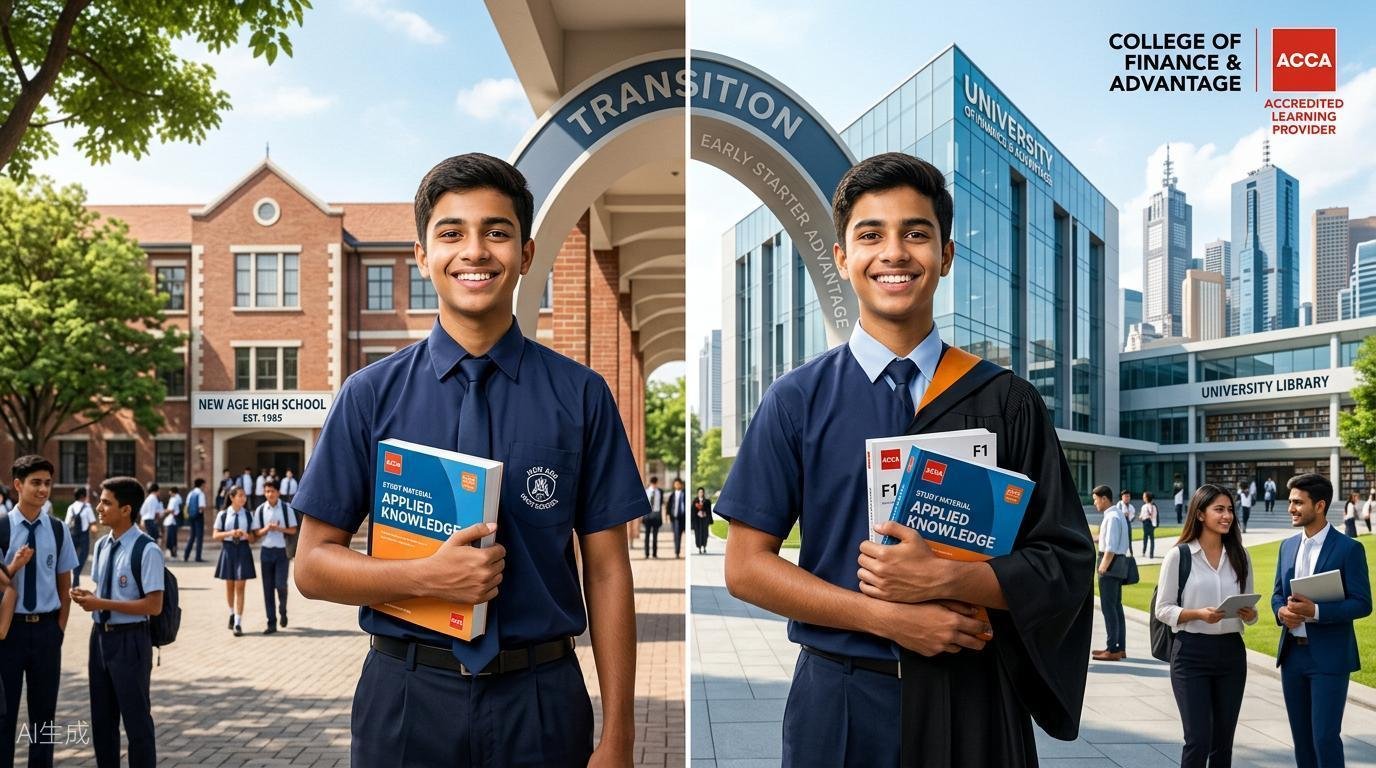
The Moment That Changes Everything
It is June 2026. Your 12th commerce results are out. You scored well — maybe 75%, maybe 85%. Your parents are proud. Your relatives are suggesting BCom at the local college. Your friends are all talking about which city to move to for "better opportunities."
But somewhere in the back of your mind, a question lingers: Is BCom really the best I can do? Three years of theory, outdated syllabus and a degree that every other commerce student in India has?
Then someone mentions ACCA. A global qualification. Recognized in 180+ countries. Starting salary of Rs.6-8 lakh. And the kicker — you can start directly after 12th. No need to wait for a degree. No need to spend three years doing something "safe" while your career clock ticks.
This guide is for you. We will show you exactly how ACCA after 12th works, what it costs, how long it takes and why — if you are serious about finance — it might be the best decision you ever make.
Direct Entry to ACCA After 12th: No BCom Required
Here is the most important thing most students and parents do not know: ACCA accepts students directly after 12th. You do not need a BCom. You do not need a degree of any kind. If you meet the eligibility criteria (covered below), you can register with ACCA Global and start writing papers immediately.
This is fundamentally different from CA, where you must clear CA Foundation after 12th before entering the IPCC. It is different from CS, where you need to clear the CSEET. With ACCA, your 12th marks are your entry ticket.
The direct entry route means you are studying professional-level content while your peers are still in BCom Year 1, learning introductory accounting. By the time they graduate at age 21, you could already be ACCA-qualified with 2-3 years of work experience, earning Rs.8-12 lakh per annum.
Key insight: The direct entry advantage is not just about starting early — it is about compounding. An extra 2-3 years of professional experience at the start of your career, combined with a global qualification, creates a career trajectory that BCom graduates simply cannot match without additional qualifications.
ACCA Eligibility After 12th Commerce
According to ACCA Global's official eligibility guidelines, here is what you need to start ACCA after 12th:
- Passed 10+2 (Class 12) from any recognized board (CBSE, ICSE, State Boards)
- Minimum 65% marks in Mathematics or Accounts and English (either/both)
- Minimum 50% marks in all other subjects
- No minimum age requirement (though most students join at 17-18)
That is it. No entrance exam. No interviews. If you meet these marks, you can register online at ACCA Global's website, pay the registration fee (GBP 89, approximately Rs.9,500) and start your journey.
What if you do not meet the 65% requirement? You can still start ACCA through the Foundations in Accountancy (FIA) route. FIA has three levels (Introductory, Intermediate and Diploma) that progressively build your skills. Once you complete the Diploma in Accounting and Business (equivalent to the Applied Knowledge level), you automatically transition to the full ACCA qualification. This adds approximately 6-12 months to your timeline but ensures you have a solid foundation.
Start with Applied Knowledge: BT, MA, FA
Once registered, you begin at the Applied Knowledge level — the first of ACCA's three levels. This level has three papers:
- Business and Technology (BT) — Covers business organizations, management theory and the role of technology in business. This is the most conceptual and "easiest" paper.
- Management Accounting (MA) — Covers cost accounting, budgeting, variance analysis and decision-making tools. Directly applicable to real business.
- Financial Accounting (FA) — Covers double-entry bookkeeping, financial statements and basic accounting principles. The foundation of everything that follows.
These three papers are assessed via on-demand Computer-Based Exams (CBEs). This means you can book your exam at any ACCA-approved CBE center, any day of the week and get your result immediately. No waiting for quarterly results like CA.
Most 12th-commerce students who study consistently clear all three Applied Knowledge papers within 6-9 months. At Prepper Gurukul, our average student clears BT in 8 weeks, MA in 10 weeks and FA in 12 weeks — including coaching, self-study and revision.
The ACCA After 12th Timeline: Qualified Before 22
Here is the realistic timeline for a student starting ACCA immediately after 12th commerce:
Months 1-9: Applied Knowledge Level (3 Papers)
Clear BT, MA and FA through on-demand CBEs. Study 2-3 hours daily alongside any degree program. By month 9, you have 3 papers down and a solid foundation in accounting.
Months 10-24: Applied Skills Level (6 Papers)
The sessional CBEs — Corporate and Business Law (LW), Performance Management (PM), Taxation (TX), Financial Reporting (FR), Audit and Assurance (AA) and Financial Management (FM). Take 2 papers per exam window (4 windows per year). In 12-15 months, you clear all 6 Skills papers.
Months 25-36: Strategic Professional Level (4 Papers)
The final level: Strategic Business Leader (SBL), Strategic Business Reporting (SBR) and two optional papers (Advanced Financial Management, Advanced Performance Management, Advanced Taxation, or Advanced Audit and Assurance). Take 2 papers per window. In 9-12 months, all 4 Strategic papers are cleared.
Months 30-36: EPSM + PER
Complete the Ethics and Professional Skills Module (EPSM) — an online module that takes 20-30 hours. Simultaneously, start accumulating your 36-month Practical Experience Requirement (PER) through internships, articleships, or part-time work. Many ACCA-approved employers offer structured internship programs for ACCA students.
The result: By age 21-22, you are an ACCA member — fully qualified, with 3 years of practical experience, earning Rs.8-12 lakh per annum. Your BCom-batch peers are just starting their job search at Rs.3-5 lakh.
ACCA After 12th vs BCom First vs CA Foundation
| Factor | ACCA After 12th | BCom First, Then ACCA | CA After 12th |
|---|---|---|---|
| Starting age | 17-18 (immediately after 12th) | 18-19 (after BCom starts) | 17-18 (after 12th) |
| Duration to qualify | 3-3.5 years | 5-6 years (3yr BCom + 2-3yr ACCA) | 4.5-5 years |
| Age at qualification | 21-22 | 23-24 | 22-23 |
| Exemptions | None (all 13 papers) | 4-5 exemptions | No exemptions |
| Exam flexibility | 4 windows/year, no attempt limits | Same | 2 attempts/year, low pass rates |
| Starting salary | Rs.6-8 LPA (Big 4) | Rs.6-8 LPA (Big 4) | Rs.6-9 LPA (Big 4/Articleship) |
| Global recognition | 180+ countries | 180+ countries | Primarily India |
| Total cost | Rs.4.5-6.5 lakh | Rs.6-9 lakh (BCom + ACCA) | Rs.3-5 lakh |
| Work during study | Yes (internships/articleships) | Yes | Articleship (3 years mandatory) |
For Parents: Why ACCA After 12th Is a Smart Investment
Dear parents — we understand your concerns. Your child is 17 or 18. They have just finished school. You want them to have a "safe" degree, a backup plan and a qualification that Indian employers recognize. Here is why ACCA after 12th addresses all of these:
It IS a degree-level qualification. ACCA is recognized as equivalent to a master's degree in many countries. In the UK, ACCA partners with Oxford Brookes University and the University of London to offer a BSc (Hons) in Applied Accounting and an MSc in Professional Accountancy alongside your ACCA studies — at no extra cost for the BSc.
It has a built-in safety net. Unlike CA, where failing IPCC or Final means starting over, ACCA allows unlimited attempts. Clear papers one at a time. If your child needs a break, they can pause and resume without losing progress.
The ROI is proven. According to The Wall Street School's 2026 ACCA salary data, ACCA freshers earn Rs.6-8 lakh per annum — nearly double what a BCom graduate earns (Rs.3-5 lakh). Over a 30-year career, this differential compounds to several crores.
Your child earns while studying. ACCA students can start internships from Year 1. Big 4 firms and MNCs actively recruit ACCA part-qualified students for paid internships at Rs.15,000-25,000 per month.
Total Cost: From 12th to ACCA-Qualified
Let us break down the complete financial investment for parents:
ACCA Direct Fees (Payable to ACCA Global)
| Component | Amount (GBP) | Approximate Amount (INR) |
|---|---|---|
| Initial Registration (one-time) | £89 | Rs.9,500 |
| Annual Subscription (x3-4 years) | £140/year | Rs.45,000-60,000 |
| Applied Knowledge exams (3 papers) | CBE center fees | Rs.3,000-5,000 |
| Applied Skills exams (6 papers) | £160 x 6 = £960 | Rs.1,02,000 |
| Strategic Professional Essentials (SBL + SBR) | £282 + £208 = £490 | Rs.52,000 |
| Strategic Professional Options (2 papers) | £208 x 2 = £416 | Rs.44,000 |
| EPSM Module | £83 | Rs.8,800 |
| Total ACCA Fees | Rs.2.6-2.8 lakh |
Coaching and Study Material Costs
| Component | Approximate Cost (INR) |
|---|---|
| Coaching for 13 papers (per paper) | Rs.8,000-15,000 |
| Total coaching (13 papers) | Rs.1.5-2.5 lakh |
| Study materials and revision kits | Rs.20,000-30,000 |
| Mock exams and revision batches | Rs.15,000-25,000 |
| Total Coaching & Materials | Rs.1.85-3.05 lakh |
Grand Total: Rs.4.5 to 6.5 lakh over 3-3.5 years.
Compare this to: BCom (Rs.1-3 lakh) + MBA from mid-tier college (Rs.8-15 lakh) = Rs.9-18 lakh total with a starting salary of Rs.4-6 lakh. Or BCom + CA = Rs.3-5 lakh with a 4.5-5 year timeline and no global mobility. The ACCA-after-12th route delivers better outcomes at half the cost.
Career Outcome by Age 22: ACCA vs BCom Graduate
Let us look at the two paths side by side at age 22:
| Factor | ACCA-Qualified at 22 | BCom Graduate at 22 |
|---|---|---|
| Qualification status | Fully qualified ACCA + 3 years experience | BCom degree only |
| Starting salary | Rs.8-12 LPA | Rs.3-5 LPA |
| Typical employer | Big 4, MNCs, GCCs, consulting firms | Local CA firms, small companies, back-office roles |
| Job roles available | Audit Associate, Financial Analyst, Tax Consultant, Management Accountant | Junior Accountant, Accounts Assistant, Data Entry |
| Global mobility | Can work in 180+ countries | Limited to India |
| Growth trajectory | Manager by 26-27 (Rs.15-25 LPA) | May need additional qualifications for growth |
| Salary at age 30 | Rs.20-35 LPA | Rs.6-10 LPA (without additional qualifications) |
According to The Wall Street School's 2026 ACCA salary data, ACCA-qualified professionals with 3-4 years of experience earn Rs.10-18 lakh per annum. Imarticus Learning's 2026 salary guide confirms that ACCA freshers start at Rs.6-8 lakh in Big 4 firms and MNCs — nearly double the Rs.3-5 lakh that BCom graduates typically command.
The salary gap widens dramatically over time. By age 30, an ACCA-qualified professional can be earning Rs.20-35 lakh per annum as a Finance Manager or Senior Financial Analyst, while a BCom graduate without additional qualifications typically stagnates at Rs.6-10 lakh.
Should You Do BCom Alongside ACCA?
This is the question we get most often from parents. The answer is: it depends, but we generally recommend it.
Doing a BCom alongside ACCA (through distance education or a flexible regular college) gives you three advantages:
- Exemptions: A BCom degree gives you 4-5 paper exemptions in ACCA, saving you approximately Rs.40,000-60,000 in exam fees and 6-9 months of study time.
- Backup qualification: In the unlikely event that you cannot complete ACCA, you still have a BCom degree to fall back on.
- Employer preference: Some Indian employers — particularly PSUs and traditional Indian companies — still value a domestic degree alongside an international qualification.
The good news: a distance BCom from a recognized university (like IGNOU, YCMOU, or your state open university) costs only Rs.10,000-20,000 per year and requires minimal attendance. You can complete both ACCA and BCom simultaneously without any conflict. At Prepper Gurukul, we help students choose the right distance BCom program that complements their ACCA journey.
For Nagpur parents: Sending your child to Mumbai or Bangalore for ACCA coaching costs Rs.2-3 lakh extra in living expenses per year — hostel, food, travel, Mumbai rent. Prepper Gurukul offers the same Gold LP-quality education in Nagpur at a fraction of the total cost — no hostel, no travel, no Mumbai rent. Prepper Gurukul is an ACCA Gold Learning Partner serving Central India. But the same principles apply whether you are studying in Mumbai, Delhi, or Dubai — our online programs and partnerships mean geography is never a barrier.
"One of our young students started ACCA right after school and secured an internship at a Big 4 firm before turning 20. Her classmates were in BCom Year 2, earning nothing. She was earning a monthly stipend and building a professional network at a top accounting firm. That's the power of starting early. At Prepper Gurukul, we have seen this story repeat itself dozens of times — students who start ACCA after 12th consistently outperform those who wait for a degree, not because they are smarter, but because they start compounding their professional credentials 2-3 years earlier."
Your Step-by-Step Roadmap: From 12th to ACCA
Here is your action plan if you are a 12th commerce student reading this in 2026:
- Month 1 (June-July 2026): Register with ACCA Global online. Pay the registration fee. Gather your 12th marksheet and identity documents.
- Month 1-2: Enroll in a coaching program (preferably with an ACCA Gold Learning Partner). Start with Business and Technology (BT).
- Month 2-3: Clear BT via on-demand CBE. Start Management Accounting (MA).
- Month 4-5: Clear MA. Start Financial Accounting (FA).
- Month 6-7: Clear FA. You are now at the Applied Skills level. Enroll in Corporate and Business Law (LW).
- Month 8-12: Clear LW and PM in the next two exam windows. Start looking for internships.
- Year 2: Clear TX, FR, AA and FM. You now have 9 papers complete.
- Year 3: Clear SBL, SBR and your two optional papers. Complete EPSM. Document your PER.
- Month 36-42: Apply for full membership. Update your LinkedIn. Start applying for Rs.8-12 lakh roles.
Common Mistakes to Avoid After 12th
Over the years, we have seen bright 12th-commerce students make the same mistakes. Avoid these:
- Waiting for BCom to start: Every semester you delay is a semester of lost progress. Start ACCA immediately after 12th results.
- Choosing coaching based on price alone: A cheap coaching institute without Gold LP status means no exemption fee waivers, outdated materials and no direct ACCA support. Invest in quality.
- Ignoring the PER requirement: Start documenting work experience from your first internship. Do not wait until you are an Affiliate.
- Not doing a simultaneous BCom: The exemptions are worth it and the backup qualification matters. A distance BCom is low-effort, high-reward.
- Giving up after one failed paper: ACCA allows unlimited attempts. One failure is a learning opportunity, not a verdict on your capability.
The Final Word: Start Now
The difference between a student who starts ACCA after 12th and one who waits for BCom is not intelligence or talent — it is decisiveness. The student who starts at 17 will always have a 2-3 year head start over the one who starts at 21. In a career that spans 35-40 years, that head start compounds into millions of rupees in additional earnings, better roles, global mobility and professional satisfaction.
Your 12th commerce results gave you the eligibility. The rest is up to you.