
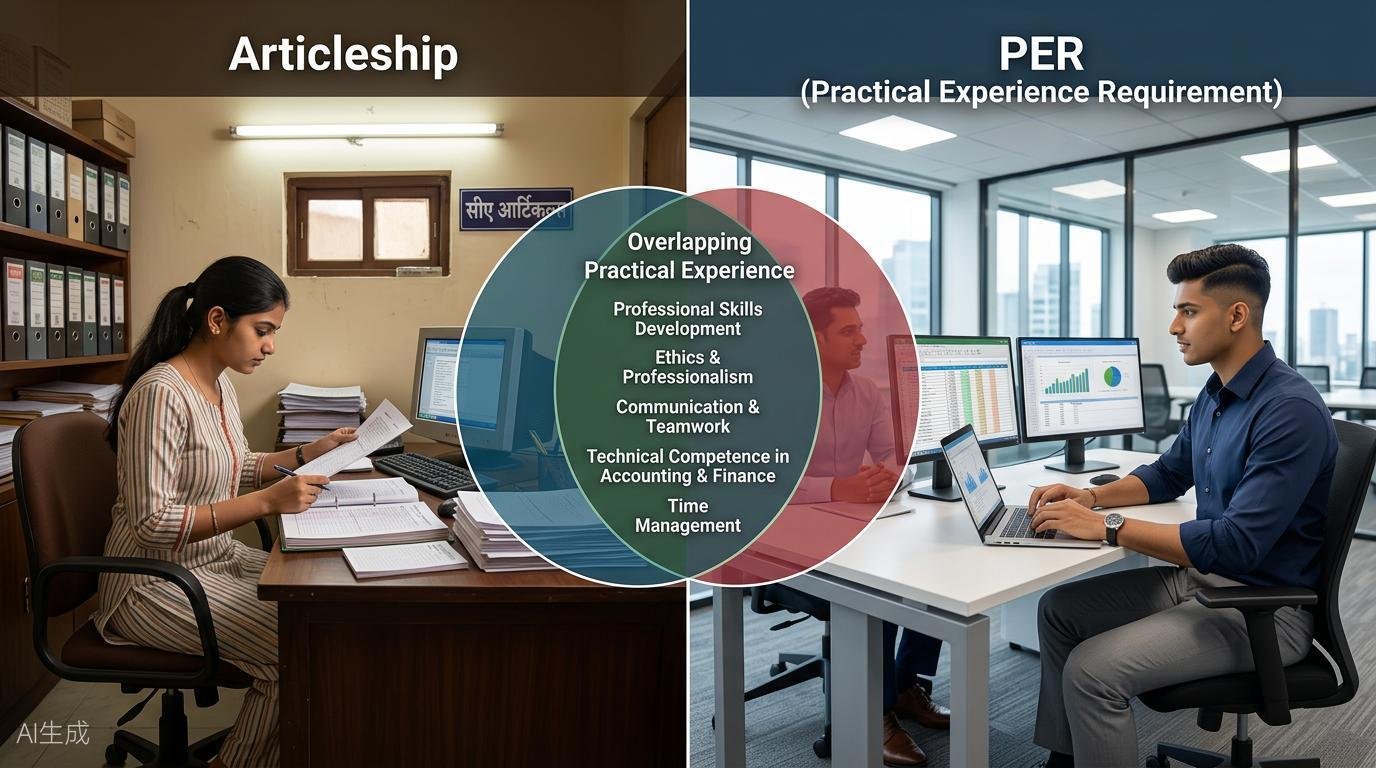
In short: ACCA's Practical Experience Requirement (PER) is 36 months of supervised work experience in a relevant finance role, which can be completed before, during, or after your ACCA exams. Indian CA articleship (3 years) typically counts fully toward PER, but you must document it properly by mapping your experience to ACCA's 9 performance objectives and obtaining supervisor sign-off through the myACCA portal.
What Is ACCA's Practical Experience Requirement (PER)?
The Practical Experience Requirement (PER) is one of three pillars you must complete to become an ACCA member — alongside passing your 13 exam papers and completing the Ethics and Professional Skills Module (EPSM). According to ACCA Global's official membership guidelines, PER requires you to complete 36 months of supervised practical experience in a role relevant to accounting, finance, or business.
What makes PER distinctive is its flexibility. Unlike CA India's rigid articleship structure, ACCA PER can be gained:
- Before you start your ACCA exams (if you have prior work experience)
- During your ACCA studies (the most common path — working while studying)
- After you have cleared all your ACCA papers
This flexibility is deliberate. ACCA recognizes that many of its students are career switchers, international students with prior qualifications, or working professionals who cannot pause their careers for a rigid training program. The PER framework is designed to capture and validate experience you may already have, while providing clear guidance for accumulating new experience.
PER is not just about clocking hours. ACCA requires you to demonstrate competence in 9 performance objectives — four essential objectives that every member must achieve and four technical objectives chosen from a list of eleven options. Each performance objective requires you to provide specific examples from your work experience that demonstrate your competence, which must then be verified by a qualified supervisor.
Understanding CA Articleship
To appreciate the differences between ACCA PER and CA articleship, it is worth understanding how the Indian CA articleship system works. Under the Institute of Chartered Accountants of India (ICAI) regulations, every CA student must complete 3 years of articleship training under a practicing Chartered Accountant before they can appear for the CA Final examination.
CA articleship is characterized by several structural features:
- Timing is rigid: Articleship must be completed after clearing CA IPCC (Intermediate) and before appearing for CA Final. You cannot articleship after completing your exams.
- Supervisor requirements are strict: You must train under a practicing CA who has been in continuous practice for at least 3 years and has adequate infrastructure to train articles.
- Scope of work: Articleship training covers statutory audit, internal audit, tax audit, direct and indirect taxation, accounting and financial management — depending on the practice areas of your principal.
- Documentation is minimal: The primary documentation is the articleship registration with ICAI and the completion certificate. There is no formal mapping of experience to specific competency objectives.
- Stipend is regulated: ICAI mandates minimum stipend payments during articleship, which vary by year of training and city tier.
CA articleship is widely regarded as one of the most rigorous practical training programs in the accounting world. The three years of hands-on experience in audit, taxation and accounting provide an exceptionally strong foundation for a career in finance. However, its rigidity — particularly the requirement to complete articleship before CA Final — is also a significant source of stress and delay for many students.
Key Differences: CA Articleship vs ACCA PER
The fundamental philosophical difference between CA articleship and ACCA PER is this: CA articleship is a training program; ACCA PER is an experience validation framework. CA articleship is designed to teach you practical skills under structured supervision. ACCA PER is designed to verify that you have developed professional competence through your work, wherever that work may have occurred.
This distinction creates practical differences across multiple dimensions:
Timing Flexibility
CA articleship must be completed at a specific point in your CA journey — after IPCC, before Final. If you interrupt this sequence, you cannot progress. ACCA PER has no such constraint. You can accumulate PER before you register with ACCA, while you are studying, or after you have cleared all exams. Many students who join ACCA after completing CA articleship already have their full 36 months of PER.
Role Flexibility
CA articleship must be completed under a practicing CA. ACCA PER can be gained in virtually any relevant finance role — industry accounting, banking, consulting, corporate finance, treasury, internal audit, or public practice. You are not restricted to working under an ACCA member.
Supervisor Requirements
CA articleship requires a practicing CA as your principal. ACCA PER requires any "qualified accountant" or senior professional who can verify your work. This includes CAs, CMAs, CSs, ACCA members, or senior finance professionals. Your supervisor does not need to be an ACCA member.
Documentation Depth
CA articleship documentation is minimal — registration and completion certificate. ACCA PER requires detailed documentation: you must map your work activities to 9 specific performance objectives, provide written examples for each and obtain supervisor sign-off for every objective. This is more work but creates a much clearer record of your professional development.
Does Indian CA Articleship Count Toward ACCA PER?
Yes — with proper documentation. This is one of the most important pieces of information for Indian students considering ACCA and it is surprising how many are unaware of it.
According to ACCA Global's PER guidelines, CA articleship counts as relevant practical experience because it involves work in accounting, audit, taxation and financial management — all activities that map directly to ACCA's performance objectives. The three-year CA articleship (36 months) typically satisfies the full duration requirement for ACCA PER.
However — and this is critical — ACCA does not automatically know about your Indian articleship. ACCA and ICAI do not share student records. Your ACCA student account will show zero PER progress until you manually enter your experience. This is where many students make costly mistakes: they complete all 13 ACCA papers, apply for membership and only then discover that they need to document their articleship experience retroactively. This can delay membership by weeks or months.
How to Map CA Articleship to ACCA PER
To ensure your CA articleship counts toward ACCA PER, follow this process:
- Register your employment: Log into your myACCA portal and enter your articleship details — employer name, your role, start date and end date.
- Map to performance objectives: For each of the 9 required performance objectives, provide specific examples from your articleship work. For instance, your audit work can demonstrate the "Audit and Assurance" technical objective, while client interactions can demonstrate "Stakeholder Relationship Management."
- Obtain supervisor sign-off: Request sign-off from your supervising CA. They will receive an email from ACCA with instructions to review and confirm your performance objectives.
- Submit for review: Once all objectives are completed and signed off, submit your PER record to ACCA for review and approval.
If your supervising CA is no longer available (retired, changed firms, etc.), contact your former employer to see if another qualified professional can verify your work. ACCA provides alternative verification pathways for genuine cases.
What Counts as PER: Eligible Roles
ACCA accepts a wide range of finance-related roles for PER. According to ACCA Global's official guidance, eligible roles include:
Roles That Count Toward PER
- Accounting roles: Financial accounting, management accounting, cost accounting, financial reporting, consolidation accounting
- Audit roles: Statutory audit, internal audit, compliance audit, operational audit, risk-based audit
- Taxation roles: Direct tax (income tax), indirect tax (GST), international tax, transfer pricing, tax advisory
- Financial analysis and planning: Budgeting, forecasting, financial modelling, business analysis, management reporting
- Consulting and advisory: Business consulting, risk advisory, transaction advisory, due diligence
- Treasury and financial management: Cash management, working capital management, foreign exchange, treasury operations
- Corporate finance: M&A support, valuations, fundraising, investor relations
- Governance and risk: Risk management, compliance, corporate governance, internal controls
Part-Time Work and Internships
Part-time work counts toward PER on a pro-rata basis. If you work 20 hours per week for 2 years, that equals approximately 12 months of PER. Internships also count if they meet the minimum duration requirement and involve relevant work activities. The key is that your role must provide opportunities to develop the competencies required by ACCA's performance objectives.
How to Document PER: Step-by-Step Guide
Log Into myACCA and Access the PER Section
Navigate to the "Practical Experience Requirement" section from your myACCA dashboard. Familiarize yourself with the layout — you will be recording employment, adding performance objectives and requesting supervisor sign-off from this portal.
Record Your Employment History
Add each relevant role with accurate dates. For CA articleship, enter your principal's firm name, your designation (Article Assistant) and the exact start and end dates. Be precise — ACCA may verify dates with your employer.
Complete the 4 Essential Performance Objectives
All 4 essential objectives are mandatory. For each, write a detailed statement (200-500 words) describing specific situations from your work where you demonstrated the required competence. Use the STAR format: Situation, Task, Action, Result.
Complete 4 Technical Performance Objectives
Select 4 technical objectives that align with your work experience. If your background is in audit, choose audit-related objectives. If you worked in industry accounting, choose financial reporting and management accounting objectives.
Request Supervisor Sign-Off
Enter your supervisor's email address in the myACCA portal. They will receive an invitation to review your performance objective statements and confirm (or request revisions to) your claims. Follow up with your supervisor to ensure they complete the sign-off.
Submit for ACCA Review
Once all objectives are signed off, submit your complete PER record to ACCA. The review process typically takes 2-4 weeks. ACCA may contact your supervisor for verification or request additional information if any objectives are unclear.
The 9 Performance Objectives Explained
ACCA's performance objectives are organized into two categories: 4 Essential (mandatory for all) and 4 Technical (choose from 11 options). Each objective has specific competence statements that define what you must demonstrate.
Essential Objectives (All 4 Required)
Ethics and Professionalism
Demonstrate ethical behaviour, professional values and judgement in your work. Examples: resolving ethical conflicts, maintaining confidentiality, demonstrating integrity in client dealings.
Stakeholder Relationship Management
Manage relationships with stakeholders effectively. Examples: client communication, managing expectations, presenting to senior management, handling disputes professionally.
Strategy and Innovation
Contribute to strategic thinking and innovation. Examples: participating in strategic planning, proposing process improvements, identifying growth opportunities, adapting to change.
Governance, Risk and Control
Understand and apply governance, risk management and internal controls. Examples: evaluating internal controls, identifying business risks, ensuring compliance with regulations.
Technical Objectives (Choose 4 from 11)
Financial Accounting and Reporting
Prepare, analyse and interpret financial statements. Examples: preparing annual accounts, consolidation, IFRS application, financial statement analysis.
Management Accounting
Use management accounting techniques for decision-making. Examples: budgeting, variance analysis, cost management, performance measurement.
Taxation
Prepare tax computations and advise on tax planning. Examples: income tax returns, GST compliance, tax advisory, transfer pricing documentation.
Audit and Assurance
Plan and perform audit and assurance engagements. Examples: statutory audits, internal audits, audit reporting, risk assessment procedures.
Financial Management
Apply financial management techniques. Examples: investment appraisal, working capital management, financing decisions, business valuation.
Leadership and Management
Lead teams and manage resources effectively. Examples: team supervision, project management, resource allocation, mentoring junior staff.
Data Analytics
Use data analytics tools and techniques. Examples: data visualisation, financial modelling, using analytics software, data-driven decision making.
Case Study (Integrated)
Demonstrate integrated professional competence across multiple areas in a complex scenario.
CA Articleship vs ACCA PER: Comparison Table
| Dimension | CA Articleship (India) | ACCA PER |
|---|---|---|
| Duration | 3 years (36 months) fixed | 36 months flexible |
| Timing | After IPCC, before Final (rigid sequence) | Before/during/after exams (flexible) |
| Supervisor | Practicing CA only | Any qualified accountant or senior professional |
| Type of Work | Audit, tax, accounting under a CA | Any relevant finance role (industry, practice, consulting) |
| Documentation | Registration + completion certificate | Employment record + 9 performance objectives + supervisor sign-off |
| Competency Mapping | None formal | Mandatory — map to 9 specific objectives |
| Part-Time Work | Not permitted (full-time only) | Counts pro-rata |
| International Recognition | Primarily India-focused | Recognized globally |
| Stipend/Salary | Regulated stipend (ICAI minimum) | Market salary (no regulated minimum) |
| Mobility Between Firms | Requires ICAI permission | Free to change employers anytime |
From Nagpur and Central India
CA Articleship to ACCA PER: The Nagpur Advantage
For Nagpur students with CA articleship experience, the good news is that your 3-year articleship likely counts fully toward ACCA's 36-month PER requirement. At Prepper Gurukul, we help students document their articleship experience correctly so they can apply for ACCA membership immediately after clearing all papers.
Prepper Gurukul is an ACCA Gold Learning Partner serving Central India (Maharashtra, M.P. and Chhattisgarh). But the same principles apply whether you are studying in Mumbai, Delhi, or Dubai — our online programs and partnerships mean geography is never a barrier. Many of our students come from CA backgrounds and are pleasantly surprised to learn that their articleship puts them significantly ahead on the PER requirement — they just need to document it correctly.
Faculty Perspective on PER
"The biggest PER mistake we see: students who completed CA articleship but never documented it properly for ACCA. ACCA doesn't automatically know about your Indian articleship. You need to map your experience to ACCA's 9 performance objectives and get your supervisor's sign-off. Do this from Day 1, not after clearing all papers. Every year, we have 3-4 students who clear all 13 papers, celebrate, apply for membership and then face a 2-month delay because their PER documentation is incomplete or their supervising CA has retired and can't be reached. The work is already done — the articleship is complete. The only thing missing is the paperwork. Treat PER documentation as seriously as you treat exam preparation."