
Pass Rate Overview: What the Numbers Tell Us
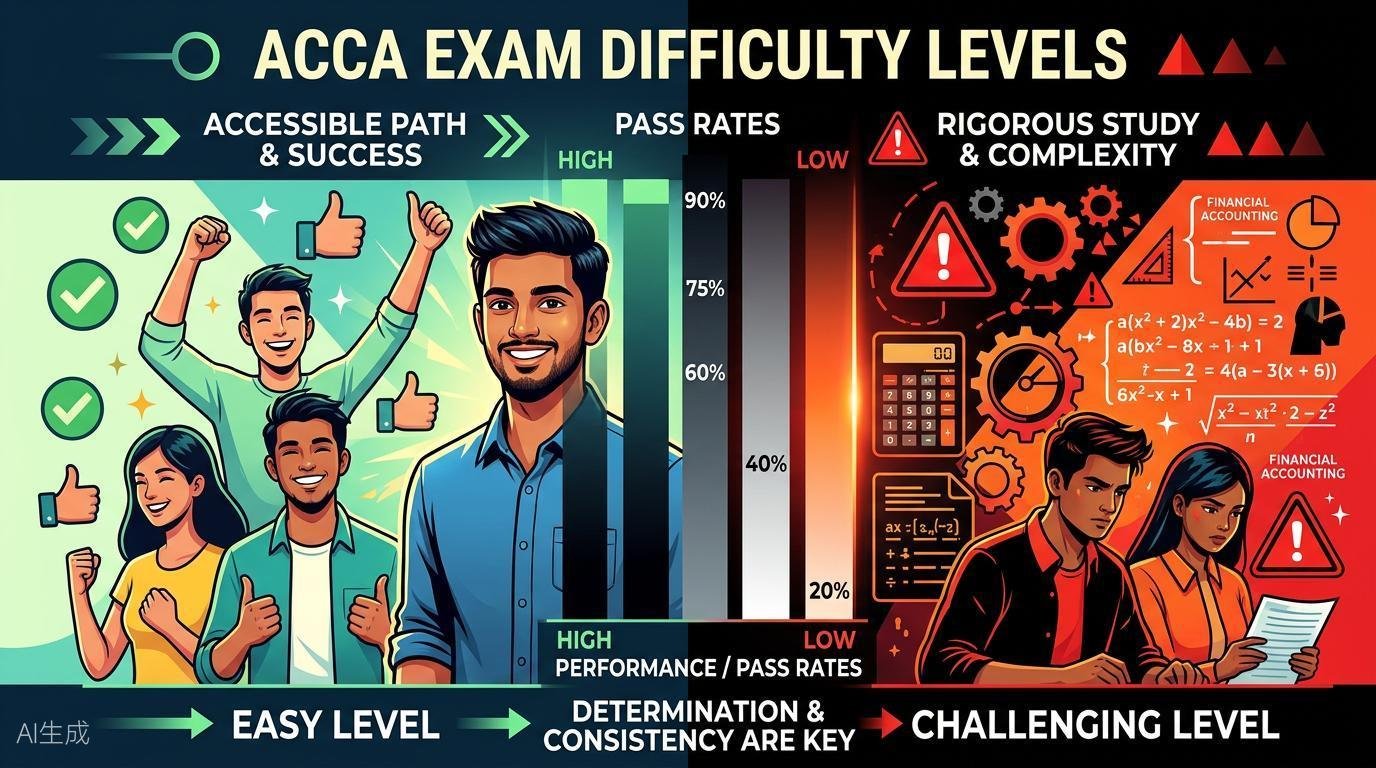
According to ACCA Global's official pass rate statistics, the most recent data reveals a clear pattern: Applied Knowledge papers have the highest pass rates (64–88%), Applied Skills papers sit in the middle (40–55%) and Strategic Professional papers have the lowest (30–52%). This isn't accidental — ACCA deliberately increases complexity as you progress through the qualification.
The December 2024 session data from ACCA Global shows BT leading at 87%, while AAA trailed at just 39%. But these numbers tell only part of the story. A high pass rate doesn't mean a paper is "easy" — it often means the right students are attempting it. Conversely, a low pass rate sometimes reflects who attempts the paper (many retakes) rather than pure difficulty.
All 13 Papers: Pass Rates, Difficulty & Study Hours
Here's the complete breakdown using the latest available data from ACCA Global (averaging December 2024, March 2025, June 2025 and September 2025 sessions where available):
| Paper | Name | Typical Pass Rate | Difficulty | Study Hours |
|---|---|---|---|---|
| BT | Business & Technology | 85–88% | Easy | 80–100 |
| LW | Corporate & Business Law | 79–82% | Easy | 80–100 |
| FA | Financial Accounting | 67–70% | Easy-Mod | 100–120 |
| MA | Management Accounting | 64–68% | Moderate | 100–120 |
| TX | Taxation | 50–55% | Moderate | 150–180 |
| FM | Financial Management | 46–51% | Moderate | 150–180 |
| FR | Financial Reporting | 48–51% | Moderate-Hard | 180–200 |
| SBL | Strategic Business Leader | 48–53% | Hard | 200–220 |
| SBR | Strategic Business Reporting | 48–52% | Hard | 200–220 |
| PM | Performance Management | 40–45% | Hard | 180–200 |
| AFM | Advanced Financial Management | 42–46% | Hard | 200–250 |
| ATX | Advanced Taxation | 40–50% | Hard | 200–250 |
| APM | Advanced Performance Management | 32–40% | Very Hard | 220–260 |
| AA | Audit & Assurance | 38–47% | Very Hard | 180–220 |
| AAA | Advanced Audit & Assurance | 30–38% | Extreme | 250–300 |
Source: ACCA Global pass rate statistics (accaglobal.com), averaging multiple sessions 2024–2025. Pass rates fluctuate by 2–4% each session.
Difficulty Ranking: Easiest to Hardest
Based on the composite data above, here's the ranking from easiest to most challenging:
Tier 1: Accessible (Pass Rate 65%+)
BT, LW, FA, MA — These Applied Knowledge papers are designed to build foundational confidence. The high pass rates reflect their role as entry points. BT tests broad business awareness (technology, governance, organisational structure). LW tests company law and contract law — manageable if you have a good memory for legal sections. FA and MA test core accounting and costing concepts that most BCom students have already encountered.
The trap: Students see the 85%+ pass rate for BT and assume they don't need to study. This is a mistake — BT's CBE format requires familiarity with the exam platform and students who walk in unprepared often fail despite the paper being "easy" in content terms.
Tier 2: Moderate Challenge (Pass Rate 45–55%)
TX, FM, FR, SBL, SBR — This is where ACCA separates students who understand concepts from those who can apply them under exam pressure. TX requires detailed knowledge of tax computation formats. FM tests investment appraisal and risk management with complex calculations. FR is the make-or-break paper for many — it requires application of IFRS standards to complex group scenarios.
SBL is unique — it's a 4-hour case study that tests leadership, ethics and strategy simultaneously. The 48–53% pass rate hides the fact that many students fail due to time management, not knowledge. SBR tests financial reporting at the group and international level, including current developments like sustainability reporting.
Tier 3: High Difficulty (Pass Rate 35–45%)
PM, AFM, ATX, AA — These papers have low pass rates because they test specialised skills that many students haven't developed. PM requires deep understanding of variances, performance metrics and decision-making techniques. AFM builds on FM with multinational financial management, derivatives and complex valuations. ATX requires mastery of advanced tax planning — not just computation but strategy.
AA deserves special mention. Its 38–47% pass rate is deceptive because the paper isn't conceptually difficult — it's technically demanding. Students must write detailed audit procedures, evaluate internal controls and reference ISA standards precisely. Many Indian students, accustomed to numerical accounting papers, struggle with the written, discursive nature of AA.
Tier 4: Most Challenging (Pass Rate Below 35%)
APM, AAA — These two papers consistently produce the lowest pass rates. APM's 32–40% pass rate reflects its extreme subjectivity — there are often no "right" answers, only better-argued ones. The examiner expects professional judgement applied to complex performance scenarios and many students haven't developed this level of critical thinking.
AAA is the ultimate test. At 30–38%, it combines audit technical knowledge with professional scepticism, ethical reasoning and report-writing skills. Students who approach AAA as "advanced AA" are making a fundamental error — it's a completely different paper that requires strategic thinking about audit at the highest level.
Why Are Some Papers So Hard? The Real Reasons
AA: The Exam Technique Problem
AA's low pass rate isn't due to complex content — it's due to exam technique. According to ACCA examiner reports, the most common reason for failure is "failure to apply knowledge to the scenario." Students can recite ISA standards but can't write audit procedures specific to the client described in the question.
Another factor: AA is the first primarily written paper most students encounter. After numerical papers like MA, FA and PM, the shift to extended written responses catches many off-guard. The examiner expects professional-quality audit documentation — not bullet points or generic statements.
APM: The Subjectivity Trap
APM is genuinely difficult because there's often no single correct answer. The examiner presents complex business scenarios and asks you to evaluate performance using appropriate frameworks. Two students with equal knowledge can produce very different answers — and both could be correct if well-argued.
This subjectivity means marking is holistic rather than tick-based. Students who are used to calculation papers where you either get the number right or wrong find APM's marking opaque and frustrating. The key to passing APM isn't finding the "right" answer — it's demonstrating structured professional thinking.
AAA: The Synthesis Challenge
AAA requires you to combine audit technical knowledge (from AA), financial reporting understanding (from SBR) and professional ethics into a coherent response. It's not just "advanced AA" — it's a completely different assessment of your ability to think like a senior auditor facing complex ethical and technical dilemmas.
The AAA examiner frequently includes ethical scenarios where there's no clear right answer. You're expected to identify stakeholders, evaluate alternatives and recommend a course of action with proper justification. This level of professional reasoning takes years to develop — which is why the pass rate stays stubbornly low.
PM: The Calculation-Application Gap
PM's low pass rate surprises many students because the individual topics (variance analysis, budgeting, decision-making) aren't inherently difficult. The problem is application. PM questions present complex scenarios where you must identify which technique to apply, perform calculations and then interpret the results in a business context.
Many students spend too long on calculations and not enough on the written interpretation. ACCA examiner reports consistently highlight that students "calculate but don't evaluate." A PM answer needs both — the numbers and the insight.
"The paper that breaks most students isn't the hardest one — it's the one they underestimate. Business and Technology (BT) has a deceptively high pass rate of 72%, but students who skip it thinking it's 'easy' often fail because they don't practice the CBE format. We've seen students with 90% in BCom accounting fail BT because they didn't take the on-demand CBE format seriously. The lesson: respect every paper, regardless of its pass rate." — Faculty, Prepper Gurukul
How Pass Rates Have Changed Over 5 Years
ACCA pass rates have been remarkably stable over the past five years. According to ACCA Global's published data from 2020 through 2025, the range for each paper has narrowed — indicating consistent standards rather than unpredictable difficulty.
| Paper | 2021 Avg | 2022 Avg | 2023 Avg | 2024 Avg | 2025 Avg | Trend |
|---|---|---|---|---|---|---|
| BT | 84% | 85% | 84% | 87% | 87% | Stable ↑ |
| MA | 64% | 63% | 66% | 67% | 65% | Stable |
| FA | 70% | 69% | 70% | 69% | 68% | Stable |
| LW | 82% | 82% | 80% | 80% | 81% | Stable ↓ |
| PM | 40% | 41% | 41% | 42% | 43% | Stable ↑ |
| TX | 51% | 52% | 54% | 54% | 55% | Stable ↑ |
| FR | 50% | 50% | 49% | 50% | 50% | Stable |
| AA | 39% | 41% | 42% | 44% | 46% | Improving ↑ |
| FM | 51% | 51% | 50% | 50% | 48% | Stable ↓ |
| SBL | 50% | 50% | 51% | 51% | 51% | Stable |
| SBR | 49% | 49% | 50% | 51% | 49% | Stable |
| AFM | 40% | 42% | 45% | 45% | 45% | Stable ↑ |
| APM | 32% | 33% | 34% | 37% | 40% | Improving ↑ |
| ATX | 39% | 40% | 47% | 48% | 50% | Improving ↑ |
| AAA | 33% | 33% | 34% | 37% | 39% | Stable ↑ |
Source: ACCA Global official pass rate statistics, annual averages calculated across four sessions per year.
Notable trends from this data:
- AA is improving: From 39% in 2021 to 46% in 2025 — a 7-percentage-point gain. This suggests students are getting better at exam technique as coaching quality improves.
- APM is climbing slowly: From 32% to 40% — still the second-hardest paper but no longer the impossibility it once seemed.
- ATX showed a notable jump: From 39% to 50%, possibly due to clearer syllabus boundaries and better study resources.
- Knowledge papers are stable: BT through LW show minimal variation, confirming consistent difficulty and preparation standards.
Tips to Pass the Toughest Papers
For AA (Audit & Assurance) — Pass Rate 38–47%
- Practice writing, not just reading. Read the ISA standards, then immediately practice writing audit procedures for 3 different scenarios. Your answers must be specific — "check the invoice" is wrong; "inspect a sample of purchase invoices to verify they are supported by valid purchase orders and goods received notes" is right.
- Learn the ISA numbers and titles. The examiner expects you to reference ISA 315 (Identifying and Assessing Risks), ISA 330 (Auditor's Responses), etc., by name.
- Do every past paper from the last 3 years. AA questions repeat scenarios with variations. Familiarity with past questions is the single biggest predictor of success.
For PM (Performance Management) — Pass Rate 40–45%
- Split your time 50/50 between calculations and written interpretation. Students who spend 80% of their time on numbers and rush the written sections consistently fail.
- Master the "recommend and justify" format. Every PM question ends with "recommend... and justify your answer." Your recommendation must be specific and your justification must link back to the scenario.
- Practice spreadsheet skills. PM's CBE format rewards fast, accurate spreadsheet work. Slow typing or formula errors cost marks you can't afford to lose.
For APM (Advanced Performance Management) — Pass Rate 32–40%
- Read business news regularly. APM scenarios are drawn from real business situations. Students who read The Economist, Financial Times, or even quality Indian business publications develop the contextual awareness that APM rewards.
- Learn the models but apply them critically. Don't just dump the Balanced Scorecard or BCG matrix into your answer. Explain why it's relevant to this specific organisation and what limitations it has.
- Write in structured paragraphs, not bullet points. The APM examiner has explicitly stated that bullet-point answers score poorly. You need coherent, argued prose.
For AAA (Advanced Audit & Assurance) — Pass Rate 30–38%
- Don't attempt AAA until you've passed SBR. AAA draws heavily on financial reporting knowledge. Students who attempt AAA before SBR are at a massive disadvantage.
- Practice the "professional scepticism" mindset. AAA isn't about finding the right answer — it's about questioning management's assertions and identifying what could go wrong. Train yourself to be sceptical.
- Master the audit report. Questions frequently ask you to evaluate whether a modified opinion is appropriate. You need to know the exact wording and circumstances for each type of modification.
From Nagpur and Central India
From Nagpur and Central India: At Prepper Gurukul, our students have performed well on FR and AA — the two papers with the lowest pass rates. Our approach: 200+ practice questions per paper, not just textbook reading. We are an ACCA Gold Learning Partner serving Central India (Maharashtra, M.P. and Chhattisgarh). But the same principles apply whether you're studying in Mumbai, Delhi, or Dubai — our online programs mean geography is never a barrier.